副刊作品参评推荐表
【英文稿】The mystery man in an old family photo and the sleuth who solved the puzzle
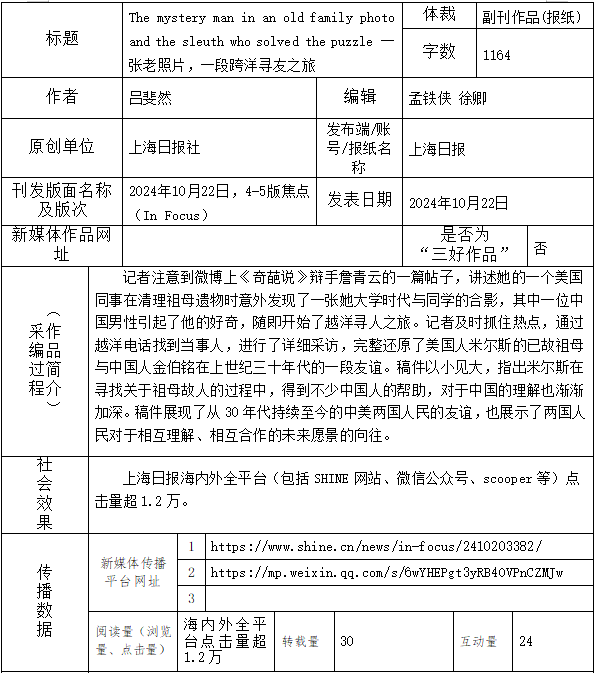
Two years ago, US attorney Eddie Mears found a photo of his late grandmother when he and his father were going through her belongings in the state of Michigan. It showed three Western ladies and an Asian man, with the inscription "To Veronica. With love. Ben."
On the back of the photo, his grandmother wrote the name Benjamin King and indicated the photo was taken at a farewell party for him in May, 1933.
The discovery led Mears on a personal odyssey to peel back the years and reveal who the mystery man was.
"My grandmother, Veronica Estelle Mears, died in 1992 when I was 6 years old, so I don't have many memories of her," Mears, an attorney now based in Japan, told Shanghai Daily on a long-distance call."But there were years when we interacted quite frequently because she lived not too far away. She was very warm and spent a lot of time reading books to me and my sister. I remember she once broke an arm, so we started referring to her as 'grandma with the broken arm.'"
Mears' sleuthing took him to the University of Michigan campus where his grandmother studied in the 1930s. He said she had always been an adventurous woman, traveling solo to places like Europe, Mexico and Canada, which was unusual for women at that time. In that era, it was also unusual for American students to befriend Asian foreign-exchange students.
"I read a book entitled 'The Cultural Experiences of Chinese Students who Studied in the United States during the 1930s-40s,'" said Mears."Many struggled with their coursework, with some were placed in classes not suited to their linguistic abilities. As a result, these exchange students tended to stick together and rarely made friends with American classmates, who likewise were reluctant to make friends with them. That was what made the apparent friendship between my grandmother and Benjamin so intriguing."
The intrigue led Mears to the University of Michigan campus to search through the archives, where he found several articles referring to Benjamin King. A profile of the student gradually emerged. He was very likely from China, a political activist who often attended rallies and gave several talks to student organizations and church groups about China and its ongoing tensions with Japan.
Mears also found a campus World Politics Commission led by Benjamin King, with Veronica as the group's secretary. There was the link he was searching for.
He then did research at the Bentley Historical Library on the campus and found out Benjamin's Chinese name was Gin Bo-min, who hailed from Hangzhou and graduated in 1930 from the then University of Shanghai, which is now the University of Shanghai for Science and Technology.
Mears' next step was to find the Chinese characters for Gin's name. With some digging, he managed to find a 1949 membership roster for the Rotary Club of Shanghai, which included a picture that give him his first close look at Gin.
However, the Chinese characters were so blurry that Mears had to turn to some Chinese friends and then to artificial intelligence tools to recognize them. He finally got a result: Gin was 金伯铭.
"There were several references to his studies in America in the 1930s and his subsequent profession as a banker with the National Commercial Bank," Mears said."I was confident that I now had enough information to delve deeper."
He added,"I utilized ChatGPT's translation function, which was terrific in translating Chinese-language sources," he said."It was even quite good at translating classical Chinese and scans that were blurry or degraded. Without this technology, I would have had a very hard time finding information on my own."
Gradually, the life of the "mystery man" in the picture unfolded.
In Hangzhou, Gin's father ran an antique bookstore that included tomes collected by an ancestor who was once a high-ranking official in the Qing Dynasty (1644-1911). He also discovered that Gin published a book in 1940, entitled "Banking Practices," and that Gin had divorced a wife who appeared to have been the daughter of a former president of Tsinghua University. Gin died in 1990; his three children emigrated to North America.
Several months ago, Mears visited Shanghai and Hangzhou to follow in Gin's footsteps. In Hangzhou, he found that Gin's former street address ceased to exist.
One significant stop was the University of Shanghai for Science and Technology, where the campus library yielded a big surprise.
"The library was built soon after or during Benjamin's time there," Mears said."Benjamin or his family had donated money or books to the library when it opened. And there's a little QR code on the outside of the library that you can scan for its history. So I scanned it, and I was shocked to see an article that mentioned Benjamin's name. I thought,'Oh my God, here he is! He is a real being.'"
Last week, Zhan Qingyun, a Chinese friend of Mears, posted the story of his search for his grandmother's friend on the social media platform Weibo. The post went viral.
Soon Mears' WeChat account was flooded with "friend" requests, and among hundreds of messages of "good luck with the search," some netizens actually provided more information about Gin. He had two sisters who went on to become accomplished artists named Jin Qijing (金启静) and Jin Naixian (金耐先).
Looking back on the past two years, Mears said he is amazed how an old photo blossomed into such a heartfelt story.
"It's just amazing what we can do when humans pool our collective skills and talents," Mears said."It's been overwhelming. Just think about it. This is all just came from one picture in my grandmother's photo book."
His search left Mears, who went to live in Japan in 2016, with a much deeper understanding about China.
"I had visited China a few times before, but I really knew nothing about this era of history in China," he said."It was really cool to learn more about Shanghai and Hangzhou, and what circumstances were like back then. I've developed a new respect for Chinese history and feel motivated to learn more."
Mears said that the chances of finding a surviving family member of Gin's who knows anything about his grandmother are probably pretty slim, but he would love to make connections with any descendants.
"Just so I could get a deeper sense of who Benjamin King," he explained."I have this image of Benjamin in my mind based on my research, but I'm sure there are sides of him that I don't know."
He added,"I didn't get to know my grandmother all that well until I started looking for the origins of the photo. I think learning more about Benjamin, perhaps from any surviving relatives, might shed more light on my grandmother, too."
【中文译稿】一张老照片,一段跨洋寻友之旅
两年前,美国律师埃迪·米尔斯与父亲在密歇根州整理已故祖母遗物时,发现了一张老照片。照片上是三位西方女士和一位亚裔男子,题字写着“致维罗妮卡。爱你的本。”
照片背面,他的祖母写下“Benjamin King(本杰明·金)”的名字,并注明该照片拍摄于1933年5月为本杰明举办的欢送会上。
这一发现开启了米尔斯跨越时空的解谜之旅。
现居日本的米尔斯通过越洋电话告诉《上海日报》:“我的祖母维罗妮卡·埃斯特尔·米尔斯1992年去世时我才六岁,所以对她记忆不多。但她住在附近那些年我们接触频繁,她非常慈爱,经常给我和妹妹读书。记得她曾摔断过胳膊,我们就叫她‘手臂骨折的奶奶’。”
米尔斯循着线索来到祖母1930年代就读的密歇根大学校园。他表示祖母向来富有冒险精神,曾独自游历欧洲、墨西哥和加拿大,这在当时女性中实属罕见。那个年代,美国学生与亚洲留学生建立友谊也非同寻常。
“我读过《1930-40年代留美中国学生的文化体验》一书,”米尔斯说,“许多中国学生课业艰难,有些被分到超出他们语言能力的班级。因此这些留学生往往抱团取暖,很少与美国同学交友,后者同样不愿与之深交。这更凸显我祖母与本杰明的友谊多么难得。”
在密歇根大学档案馆,米尔斯发现多篇提及本杰明·金的文献。这位学生的形象逐渐清晰:他很可能来自中国,身为政治活动家常参加集会,向学生组织和教会团体讲述中日紧张局势。米尔斯还找到一个校园“世界政治协会”的记录,本杰明担任其主席,而维罗妮卡正是该组织的秘书——这正是他寻找的关联证据。
在本特利历史图书馆,米尔斯查实本杰明中文名为“Gin Bo-min”,来自杭州,1930年毕业于当时的沪江大学(现上海理工大学)。
在1949年的《上海扶轮社成员名册》中,米尔斯找到一张Gin Bo-min的照片以及他的汉语名字,但是图片非常模糊。最终,凭借中国朋友的帮助和AI图像识别技术,他锁定了"金伯铭"三个字。
“多方资料显示他曾在上世纪三十年代留学美国,回到中国后在浙江实业银行任职,”米尔斯说,“此时我已确信掌握了深入研究的基础。”
他特别提到:“ChatGPT的翻译功能在处理中文资料时表现惊艳,连文言文和模糊扫描件都能较好处理。若没有这项技术,我的独立研究将举步维艰。”
渐渐地,祖母照片中"神秘男子"的人参画卷在米尔斯面前徐徐展开:金伯铭的父亲在杭州经营古籍书店,藏有清代高官先祖的典籍;金伯铭1940年出版了《银行实务》专著;他曾与清华大学某校长之女结婚又离婚离婚;1990年去世后,三个子女移居北美。
数月前,米尔斯层专程赴上海与杭州寻访金伯铭的故迹。在杭州,金氏旧居已无处可寻;而在上海理工大学图书馆,他获得重大发现:“这座图书馆建于金伯铭就读时期或他毕业后不久,开馆时金氏家族曾捐赠资金或书籍。扫描外墙二维码查看馆史时,我震惊地发现了金伯铭的名字——天啊,他真的存在过!”
上周,米尔斯的中国朋友詹青云将这段寻人故事发布在微博平台,迅速引发热议。米尔斯的微信瞬间涌入大量好友申请。在数百条"祝寻人顺利"的留言中,有网友补充了金氏家族信息:金伯铭两位胞妹金启静、金耐先后来都成为杰出艺术家。
回顾这两年寻访历程,米尔斯感慨一张旧照竟能延伸出如此温暖的故事。“人类汇聚智慧与才能时能创造的奇迹令人惊叹,”米尔斯说,“这段旅程充满惊喜。谁能想到,一切始于祖母相册里的一张照片?”
对于2016年起旅居日本的米尔斯而言,这次寻访让他对中国有了更深认知。"此前虽多次到访中国,但对此段历史知之甚少。能够深入了解上海与杭州两座城市及其历史风貌真的非常棒,我对中国历史产生了新的敬意,渴望能够继续探索。"
米尔斯坦言找到知晓其祖母往事的金氏后人机会渺茫,但仍期待与任何后裔建立联系。“我希望能更立体地认识本杰明·金,”他解释道,“通过研究我已勾勒出他的轮廓,但必定存在未知的侧面。”
但他的目的也并不仅仅如此。“直到开始追查这张照片的渊源,我才真正开始了解祖母。”米尔斯说,“或许通过金氏后人的叙述,既能更完整地拼凑本杰明的人生图景,也能照亮祖母生命中的隐秘角落。”
选稿:朱雯